SIA: Black Diamond update

Posted by – February 4, 2012

Though Frank and I are not true to one brand for all of our gear, there is no doubt that Black Diamond is among our favorites. We spent quite a bit of time checking out next year’s line up of new gear. Here’s some of what we found.

The patent ran out on Flicklock, so they developed a new and improved version of their current Flicklock system. This one will be more user friendly, with a wider lock lever. Also, it’s less likely to loosen, which sometimes occurred with the old Flicklock system.
Photobucket

Photobucket

You’ll notice a wider hold on the top of the pole grip, for better gripping with the palm when you need it most. The Whippet largely remains the same, with a few minor changes to the grip.
Photobucket

Black Diamond skins are currently our favorite skins on the market. Gaining popularity is the split skin, shown on the left, intended for skis 115 mm or wider underfoot. With backcountry skiers venturing further with fatter skis, this skin fits a growing niche in the market. The goal of this skin is to save a bit of weight while also significantly improving glide.
Photobucket

Users will notice some changes in the BD skins as well. They’ve made them noticeably thinner, for a beneficial weight savings. At the same time they changed their glue to improve adhesion in colder weather. Lastly, but perhaps more importantly, they lengthened the “hairs” on the skin, to improve both glide and traction.
Photobucket

One of the neatest changes we saw was the addition of the Ergoactiv system to their Covert pack. This unique system allows for flexibility at the waist.
Photobucket

Photobucket

Observing the system and how it works is one thing, but actually trying it on is another. Both Frank and I were pleasantly surprised at how noticeable this feature is on the pack. This Ergoactiv system improves both comfort and flexibility, especially when you need to bend down and mess with something on your boot or bindings. We felt that more packs should carry this feature.
Photobucket

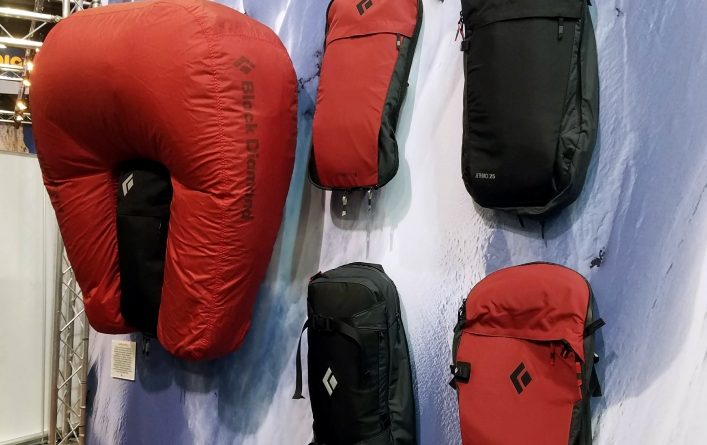
While most backcountry skiing pack companies are in the process of developing some sort of airbag system, Black Diamond has taken a step back in this technology. We were informed that BD will produce an air bag pack, but they are grappling with whether to continue to incorporate the Avalung or not. Have airbag packs made the Avalung obsolete? Or is there still a need for both features in a pack? These questions are an ongoing discussion. It will be interesting to see what BD develops from this in the future.

For ski boots, the line remains unchanged from the current season. Look for changes in 2013-14.

Thanks for the detailed tour BD!

Seth Morrision’s “The Ordinary Skier”

Posted by – February 2, 2012

This winter in (most) of the Western USA got you down? Here’s a couple of solutions.

First, pick up a pair of these skis. AT $199, plus a free ski bag, plus free shipping, plus no tax in most states, how can you not?

Then, basking in the glow of your purchase, check out “The Ordianary Skier”. I really enjoyed watching Seth Morrison getting his ski mountaineer on in Chamonix. Great Flick- free right now on hulu. Enjoy:

A Little Bit of Backcountry

Posted by – February 2, 2012

Scary is just one of the words I’ve used to describe Colorado’s snowpack this year. With recent snowfall on top of thick unstable facet layers, this year is turning out to be the kind that makes you really think about your backcountry choices. Frank and I hazard to even venture to some of our winter standards. That being said, this weekend we decided to take a walk outside the gates for a bit of mellow terrain on Loveland Pass. We weren’t out for long, but we still took the time to get just a few pictures.

The sky was beautiful in the late afternoon.
Photobucket

Hagar and Citadel in the distance.
Photobucket

Kim.
Photobucket

Photobucket

Frank.
Photobucket

This backcountry experience had me hyper-alert compared to most others, simply due to the snow pack. While I love the backcountry and what it has to offer, Frank and I wish to stay safe and will be backing off from it for a while – likely until we head to Alaska in just a little over two weeks. Until then, enjoy the reviews and other food for thought we offer!

SIA: Binding Wars- Tyrolia/Head and Salomon/Atomic

Posted by – February 1, 2012

The Marker Duke and Baron bindings have proven to be very popular over the last few years, so it certainly shouldn’t be a surprise that some of the other big players on the downhill binding market are now providing some competition. This class of binding deserves its own name- perhaps “Downhill Touring” (DT) or “Freeride Touring” (FT). Another player in this category is the MFD Alltime, a hinged plate that you can attach almost any standard alpine binding. Yes, they tour to an extent, but not like a Dynafit/tech binding or even a Fritchi. But that doesn’t mean I don’t like the category.

First, some thoughts on my Dukes. I actually like them a lot. Unlike my Fritchis or Dynafits, I can ski them inbounds with 100% confidence. Additionally, unlike my Dynafits I can quickly change from my alpine boots to my AT boots. When I’m unsure if I’ll be touring or skiing inbounds, I can limit myself to the Dukes without compromising too much touring or aggressive skiing inbounds. But any tour more than a couple of hours is just plain brutal.

They’re also very useful for the lazy man’s versions of backcountry skiing- namely slackcountry and sled laps. This is a topic that is rarely discussed, but should honestly be on your mind when you do tours of this type. Let’s say you’re in Jackson Hole and you head out the Rock Springs gate and hike up the pre-existing boot pack. You ski first and then watch your partner get caught in a slide above you. If you’re in standard alpine bindings and you have no skins, you’ve basically signed your partners death certificate- you’ll spend an hour postholing up to the debris just to break out your beacon/probe/shovel to find a corpse. So please, if you find yourself skiing slackcountry make sure you have some sort of backup plan (a touring binding of some sort plus skins) to reach your partners.

Enough of that, let’s get to the Tyrolia/Head offering, the Adrenalin, complete with a high DIn setting of 16.

Tyrolia’s offering seeks to differentiate itself through a “floating” heelpiece. All the cool new ski designs are rendered somewhat moot if a DT binding, with its huge rigid zone, doesn’t allow the ski to flex the way its designers intended. So the Tyrolia binding doesn’t fix the heel of the binding in place- instead it has 2 small cylindrical tabs mate up with two similar tabs on the fixed part of the heel to lock it down while still allowing movement. Even a quick hand flex of a ski will show the system works. The system is visible on the brushed metal fixed part of the binding and the “rail” of the binding above it. Also, unlike the Duke, you don’t have to step out to go from ski-hike-ski modes. The question we’d like to see answered in real-life usage is whether or not the system ices up during the skin, making it difficult to get into ski mode (the duke requires careful cleaning of its track to lock it down).

Does it work in practice? We won’t know unless we get a chance to try the binding out on the snow. Another feature of the binding is that you can adjust the binding length without tools- but really, how hard is it to use a leatherman, even out on the trail? Then there’s this:

Yes, that’s plastic connecting the toe and heel. Not a single bit of metal in there. Now, I had the original white Fritchi Titanal binding, and I broke the metal connecting rod on that binding in relatively short order. The next Fritchi, the blue Titanal 2, had a much stronger and heavier connecting bar that I never did break. I can only hope that Tyrolia did their homework- if that plastic breaks on a skier somewhere exposed, it’s going to be a nasty accident. I’m not sure I trust it, that’s all I can say, but time will tell with this binding. Reported (unverified) weight is 40g more than the Duke, and well over 100g lighter than the Salomon.

Speaking of which, on to the Salomon Guardian.

Like the Tyrolia, the Guardian lets you switch modes without stepping out. This is something that drives me crazy about not only my Dukes, but also my Dynafits. Hit the flats at the end of the run- boom, go to tour mode. It gets steeper again- boom, go to ski mode. This feature alone gets me excited about this binding. The “teeth” that lock the binding down in ski mode look less prone to ice and snow buildup as well. Also like the Tyrolia, this binding isn’t entirely “fixed”, allowing the ski to flex naturally. It’s interesting to note that both bindings addressed both of these Duke downfalls. Still, I’ll take a wait and see approach with this binding given Salomon’s other ill-fated forays into the touring world.

More on the Tyrolia:

More (a lot more, at almost a half hour) on the Salomon:

SIA: Tecnica Cochise, Cochise Light, and Cochise Pro

Posted by – January 31, 2012

Brittany headed down to Denver last weekend to attend the SIA show and check out some new gear. We have a lot of “quick-look” products to show everyone, and hopefully we’ll get a chance to thoroughly test and review some of these products in the near future. We’d love to throw in some fun stoke from the backcountry as well, but we’ve pretty much cut out backcountry skiing for the time being thanks to the horrible snowpack we have here in most of Colorado. At least we have Alaska to look forward to in the near future.

In any case, one of our first stops was the Tecnica booth. I’ve been extremely happy with my Cochise boots (REVIEW HERE), but I wanted to learn more about them as well as some new offerings in the Cochise line-up. In my review, I stated that the Cochise boot was the first AT boot I’ve skied that truly skied like an alpine boot, something I’ve always wanted and hadn’t previously found. So why do they ski so well?

Not surprisingly, they ski well because Tecnica did their homework. AT boots present a bit of a challenge for boot designers. After all, they’re supposed to be light, have a tremendous range of motion, grippy soles, and then turn around and perform well on the descent. In an alpine boot, the upper and lower cuffs work as one unit, and inputs from the leg are quickly and decisively transferred from the boot to the ski. AT boots, on the other hand, have to separate the upper and lower in order to achieve a range of motion while in walk mode. In general, the upper and lower are connected in three places- the two hinge points at the ankles, and usually with a metal bar or rod in the back of the boot. Just how much lateral stiffness does that provide? Even rearward in some cases? Not much, in my experience. That’s great if the latest greatest stiff boot claims a forward flex of 200- if the lateral flex doesn’t match it, you might as well put some dynafit fittings in your street shoes and ski that way.

Tecnica tried to mate the upper and lower cuffs of the Cochise, and I think they’ve made some great strides in that area. Here’s the lower- notice the metal “H”:

Here’s a combo view with part of the lower cut away. There’s a lot to look at- notice for one thing that the screws on the replacable soles go into T-nuts. Then there’s the Tech fitting (sitting by itself in the heel pocket) that also has metal reinforcement. But you’ll really want to check out the “T” fitting tied to the string in the middle of the boot. This is the part on the upper that fits into the “H” seen above. Click, click- upper and lower mated so much better than before.

Read more

Video: Float Airbag in Action, Summit County 1.25.12

Posted by – January 29, 2012

Check out this video of a slide near Montezuma just a few days ago. Apparently this was a run in a “friendly, winner-take-all” competition. Plenty to talk about regarding backcountry competitions in questionable terrain with the sketchy CO snowpack this year, but we’ll leave it up to commenters. Thankfully the BCA Float Airbag worked well…

Wonder if they sell the most important piece of backcountry gear here:

Kudos if you know what it is. Stay safe out there folks.

Review: Tecnica Cochise AT ski boots

Posted by – January 26, 2012

I’ve never considered my dream AT boot to be that difficult to find. More than anything, I just want an AT boot to perform on the way down in the same manner as an alpine boot. If I can’t tell that I’m in an AT boot, then my dreams have been fulfilled. Just add a good walk mechanism and a rubber sole with tech fittings, and I’m in heaven. Did Tecnica fulfill my dreams… read on.
L-R: Dynafit Zzeus, Tecnica Cochise, Tecnica Diablo Magma (alpine):
Photobucket

Photobucket

In 1985, as a J3 racer at the Winter Park Comp Center, I started skiing in my first pair of Tecnica boots- the neon Grand Prix racers. Since that time, I have skied Tecnica boots almost exclusively. Yes, I’m a Tecnica fan. They fit my foot and the flex is natural for me. So to say I was excited about the Cochise AT boot is a bit of an understatement. As I slid my foot into this boot, it indeed felt like coming home to an old friend. Still, like other reviewers of this boot, I noticed that they have a lot of room- but that’s easily remedied with some shims under the liner. That’s about all I had to do to get them dialed with my feet.

The ski/walk mechanism on this boot is a thing of beauty- simple, easy to use with gloves, with a solid, positive click between modes. What was more impressive, however, was the smoothness of the boot in walk mode. After dealing with the clunky, herky-jerky motion of my old Dynafit Zzeus boots, the Cochise felt amazing in comparison.
Photobucket

In fact, the smoothness of the Cochise walk mode made me assume that the range of motion was far greater than that of the Zzeus. Turns out it’s about the same in a rearward motion, but less than the Zzeus in the forward motion. Still, in practice I would say that the Cochise is a far more capable touring boot than the Zzeus. Comparison shots:
Photobucket

Photobucket

So, the question remained… would the Cochise ski as well as my Magma alpine boots? The answer, I’m pleased to report, is yes. I’ve skied the Cochise boots inbounds quite a bit this season, something I wouldn’t even consider with my Zzeus boots. They handle it well. Still, I will always have alpine boots for inbounds days- for someone who skis as much as me, it makes no sense to ski an AT boot inbounds except when traveling. In my view, any time you add moving parts (the ski/walk mode), you’ve got a part that can wear out or break, so why stress it pounding out more vert in a day than one might get in a month of touring. The same goes for touring bindings, in my opinion. And then there’s the folks who insist on skiing rubber soled boots in standard alpine bindings- might as well just put a bullet in the chamber and play Russian roulette with your knees. But I digress…

The liner is mediocre. I’ll use them for the rest of this season, but then I’ll upgrade to an Intuition or Palau liner next year. One problem has been a fold in the tongue which is meant to help the touring motion. While it sounds good on paper, in practice it ends up being a part of the tongue which always wants to fold over produce a sharp pain. The tongue needs to be positioned perfectly for me to avoid this. The oval area in this photo by my finger is the area I’m talking about:
Photobucket

The other issue with the liner is the plastic liner covering clashes with the plastic cuff of the boot in tour mode. This produces an annoying click from time to time when the boot is getting the maximum range of motion, as on a flat section of skintrack or while walking. Look at the red spot on the liner and I think you’ll see what I mean.
Photobucket

Still, these are minor quibbles thanks to the downhill performance of the boot. Last season, I found myself using my alpine boots for short tours, not willing to sacrifice performance for the sake of touring comfort. Thankfully, that will not be a type of torture I will endure any longer. Surprisingly, with all this performance they’re still lighter than many other boots in the same class, including the Zzeus and Titan boots from Dynafit, and Black Diamond’s Factor boots.

In summary, I am extremely pleased with these boots. The downhill performance was somewhat expected- the touring capabilities of this boot are much better than I could have even hoped for. They’re the boots I’ve been waiting for. It’s been a long wait.

Weekend Powder Stoke (21 & 22 Jan 2012)

Posted by – January 22, 2012

The town was buzzing on Friday, knowing that the first significant snowfall for months was quickly approaching. NOAA forecasted the storm would hit at 11 am on Saturday morning. Flakes began to fall from the sky at 10:30 that morning, and we were elated. We let the snow accumulate while we worked on a few projects in our apartment. But, when we looked glanced out the window at 11:30, we realized it had already snowed a couple of inches. It was time to grab the skis and go!

It dumped all afternoon, yet the lines were like this.
Photobucket

The snow continued to fall all day long. When I took a quick break, I came out and my skis had been quickly buried.
Photobucket

The skiing got better and better throughout the day. And during our last two runs, we decided to grab a few quick shots.

Frank sporting his tele-steeze.
Photobucket

Read more

Gear Review: Marmot Power Stretch Hoody

Posted by – January 21, 2012

I recently purchased a Marmot Power Stretch Hoody and have been so happy with it, that I wanted to make sure I let our followers know about this fantastic product.
Photobucket

The Marmot Power Stretch Hoody is one of those versatile pieces that I love so much. I can wear it around the house, around town, skiing, and backcountry skiing. Made from Polartech Power Stretch material, this hoody is soft to the touch, is exceptionally warm. Even better, the material is highly breathable and repels moisture, including snow, making the Power Stretch Hoody perfect for touring in the backcountry, even on big pow-days!
Photobucket

The power stretch hoody has two zippered hand-warming pockets in the front and thumb-holesin the sleeves. The hood is attached, and useful for when you need something extra to stay warm. The fabric is lightweight, so you don’t get that annoying bulky feeling that comes with some sweat-shirt type hoodies.

All in all, Marmot has designed a great product for the female athlete. Both comfortable and functional, this simple hoody has become one of the first things I grab out of my closet. I purchased my Marmot Power Stretch Hoody from Appalachian Ski & Outdoors. Be sure to check them out!

TR: Blue skies and and warm highs

Posted by – January 20, 2012

A week ago we were in the middle of a high pressure following a snow storm that dumped the first significant amount of snow we’d seen in over a month. Unfortunately, that same snow storm left us with wind that scoured our peaks. I headed out with my friends Mike, Rachel, and Grete, sticking to terrain below treeline, hoping to find decent snow in the sheltered trees.

As we skinned up, the windscouring was evident everywhere. And even though temperatures were forecasted in 20′s, it felt much warmer, as we all stripped down to our thermal layers.
Photobucket

Mike dropped in first.
Photobucket

Though the snow was certainly wind-affected, we did find some good turns. However, our turns were most abruptly interrupted when we hit old frozen tracks beneath the new snow.

Grete.
Photobucket

Rachel.
Photobucket

Mike.
Photobucket

Photobucket

Though I enjoy blue skies, it’s certainly good to have the white clouds this week. With snow falling every day since Saturday, this season is finally starting to turn :)