Category: Tech Tips

Forget A-Frame, Forget Diagonal- Pull Those Skis

Posted by – June 29, 2011

On our recent “day before the wedding” ski of Whiterock Mountain, one of the things I was most excited about was trying a different carrying method for my skis. My friend Jon Johnston has long been using this method, and since he was down from Canada for the wedding, it was the perfect time for him to show me how it’s done. A-Frame has always been my least favorite method, as it is time-consuming to set up and I always seem to hit my calves on the tails. Diagonal is a bit better for me, though it really depends on the backpack and it’s still easy to catch your tips when climbing steep terrain. Pulling the skis avoids both of these problems.
Jon showing the technique:
Photobucket

Jon gave credit to Peter Ressmann for developing the technique while they were on Mount Saint Elias along with Axel Naglich, filming the movie of the same name. It makes a ton of sense to pull skis on a huge expedition-style ascent like Mount Saint Elias, when you’d already be carrying massive loads from camp to camp. I kept seeing Jon using the method over the past few years, so it looked like it must be a viable method even on a more standard day trip. Conditions in Canada this past winter prevented me from ever trying the technique- we were too busy stepping off the snowmobiles and shredding powder spines- so I was glad Jon joined us on Whiterock for another try.

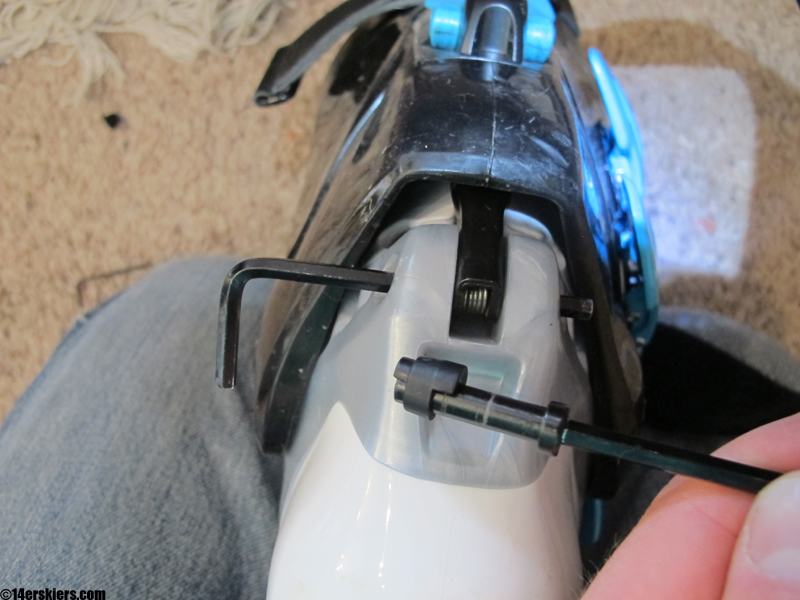
It’s pretty simple to set up. Drill a hole in each ski- I used a 3/16″ bit. Some epoxy is probably a good idea as well. Grab a few feet of cord, tie a couple of stopper knots in one end, and thread the cord through the skis. Rotate the dynafits so the brakes are up, orleave the Fritchis in the high bar so their brakes don’t drag. Tie a figure 8 into your ice axe loop on your pack and start hiking. Close-up:
Photobucket

So, how did it work? I’m not 100% sold, but it’s something I’m definitely putting in my bag of tricks. On flatter ground, it works really well- you don’t even know the skis are there. Steeper terrain really works well, too- once the backpack and the skis are more or less parallel, the skis again seem to disappear. It’s on the moderate terrain of say 30-40 degrees that I’d just assume have the skis on my pack. There’s simply something in the angle that makes the skis pull strangely on moderate slopes. One thing I was worried about was how it would pull through mixed ground, or even on the suncups of summer. It’s pretty amazing, actually- the skis simply find their way and you don’t even have to worry about them. All in all, I would recommend the technique, it’s definitely worth a try. A long, steep face climb would be the ultimate proving ground.
Photobucket

A clip from St Elias. Check it out around :20seconds…

Shop Backcountry.com CLEARANCE SALE Now – Unlimited Return Policy – Limited Time Only

Skin Glopping: Helpful Tips and Techniques

Posted by – April 2, 2010

We’ve entered that time of year when the dreaded “skin glop” begins to make its appearance. Frozen snow sticking to your skins can make for an incredibly tiring and frustrating day. For the past couple of seasons, I’ve been able to largely avoid skin glopping, even when my partners have been having trouble, which I can partly attribute to some hard work refining my skin technique. (Having said that, Murphy’s Law states that I’ll be suffering through glopping of epic proportions the next time I head out.) For those of you who have never experienced the joys of glopped up skins, it looks something like this (photo found off the internet):

Glopping occurs when skins go from a warmer, moist environment to a colder and drier one. Glopping is often a problem in the springtime because a skintrack may go from a sunny slushy slope to a shaded powdery slope (such as in the shade of a tree or on a more northerly aspect). Other ways glopping may become a problem include getting skins wet while crossing a creek, which is easy to avoid, and downhill skinning, which may warm the skins enough due to friction to cause glopping as well. To avoid glopping after a downhill skin section, simply keep moving, which will let your skins gradually readjust to a colder temperature and thereby avoid glopping.

Avoiding glopping in the sunny/shady springtime snowpack is the hardest glop scenario to avoid, but there are still a few things to do that make it less likely.

1- Stride and Glide. Like many skiers, I learned how to skin using Alpine Trekkers. Trekkers are both heavy and awkward, and they promote poor skinning technique more suited to snowshoeing than skinning. The correct skin technique leaves the skis on the snow surface, shuffling your way up the hill. Bad skin technique involves picking the ski up every step, more like walking than skinning. Leaving the ski on the snow not only takes much less energy because you don’t pick up the weight of your skis/boots/bindings/skins with every step, but it also helps avoid glopping. Every stride on the snow surface acts like a squeegee- the snow tries to stick to your skins, but it gets wiped off with every stride. Like I said, proper skin technique takes a lot less energy anyway, so it’s not a bad thing to constantly work on.

2- Don’t. Stop. Until you reach the top. [Sing it Fleetwood Mac style] This is similar to the first tip, Stride and Glide. Stopping allows time for cold snow to bond to your skins and glop up. If you continue moving, the snow simply may not have time to freeze up on your skins. If you want to talk to your partner or eat something, consider slowing to a crawl rather than coming to a complete stop. If you must take a break, choose your spot carefully- stopping right after a sunny slope enters a shady one is a near guarantee of major gloppage. Think of it as nature’s cruel personal trainer, much like the flies and mosquitos of summertime hiking and biking.

3- Choose your skintrack wisely. As I mentioned before, glopping occurs when you skin from warm areas to cool ones. If you can stay entirely in either shaded snow or sunny snow, you can avoid glopping problems. Sometimes, there simply isn’t a route choice that doesn’t go from shade to sun to shade again, as in a dense forest. However, in a sparsely treed area you might want to stay on sunny snow the entire time, putting in the occasional extra switchback to avoid the shade of a tree and the powdery snow that may lie in wait there, ready to glop up on your skins. Of course, other considerations, like choosing an avalanche-safe route, take precedence over choosing a glop-friendly route, but it’s still something to keep in mind while skinning in the springtime.

4- Use Glop Stopper. This product from Black Diamond will help stop glopping from starting, just as the name implies. It is best applied at the start of the day, rather than after glopping has started, although it is still beneficial even after glopping has started. It’s basically just wax for your skins. This product stays in my pack year-round, you never know when you’ll need it, and it also increases the glide of your skins. Weight weenies split the block in half in order to save a few grams. Here it is:

Finally, it may be time for new skins. We recommend Black Diamond skins, and would also recommend staying away from G3 skins which have been problem-prone over the years. They’re on sale right now, so springtime might be a good time to buy a new set.


Climbing skins from backcountry.com, on sale now. Free Shipping over $50.00

Anyone else have some helpful hints to avoid glopping up in the springtime? Let’s hear them…

Tech Tip: Re-glueing Skins

Posted by – February 13, 2009

I’ve heard the nightmares, but it was time for me to finally jump into the PITA otherwise known as re-glueing skins. My fatter pair of skins have seen a lot of miles, so the skin glue had finally gotten too dirty and too old to stick to my skis. I bought a Black Diamond re-glue kit from my local shop, which unfortunately doesn’t even offer to do the labor. Most decent shops should offer this service, but sadly, Crested Butte doesn’t have a decent shop.

So, I gathered as much info as possible from the internet and friends who had done it before, and gave it a shot. I am happy with the results so far, but it did take me a fairly long time (about 3 hours), and it’s a job that is a little rough on the lungs as well as very messy.

The first thing to do is cut up a paper grocery bag and use that, along with an iron, to remove the old glue and get a clean surface. It also helps if you clamp your skins down on a 2×6 or old ski, and unless you like killing brain cells, make sure it’s a well-ventilated area.
Photobucket

After you’ve heated a section, peel the paper and scrape the warm glue off of the skin. Being a drywaller, I used a drywall knife. Here’s a photo of the paper and the little round balls of skin glue that a got off of the drywall knife.
Photobucket

The skin should look nice and clean when you’re all done:
Photobucket

After that, I took the BD skin kit, which had glue sandwiched between wax paper, and laid it on the clean skin. Heat the wax paper once again with the iron, and then peel the paper off, leaving the new glue on the skin.
Photobucket

The finished product:
Photobucket

I’ve only had one chance to take them out, but so far I’m really happy with the results. I had one or two small dime-sized pieces of glue peel off the skin, but mostly, the skins appear to be as good as new. If anyone knows of some better tips and techniques, I’d love to hear them!